Showing posts with label Culture. Show all posts

Thursday, June 26, 2014

Did I miss the memo?


Living abroad means that sometimes you just don’t get the memo. In the beginning I was ever-vigilant about things like what time to actually show up when invited for lunch at 12:30, or how best to befriend your new housekeeper, communicating respect, without totally freaking her out with your openness, or who to kiss hello and goodbye (including your dentist or cardiologist) and with how many slightly audible smacks.

I got the memo in advance about what to take to the beach (i.e. not a big towel, nor nearly anything else for that matter). My husband keeps slipping me the memo about flattery working better than sternness every time I get frustrated with a bank manager. And my mother-in-law has not given up trying to get me to read the memo about the omnipotence of the Brazilian family matriarch.

If you are no longer a teenager... wear the Speedo. [These boys look like they need some sunscreen as well!]

It didn't take long after I starting living here before I had to decide on which futebol team would be “my team.” Or better put, which team “was I?” According to the memo, here in Brazil people are not asking you which team you root for, they want to know which team you are. If you are asked: “What is your favorite futebol team?” the right answer begins with: “I am….” Nowadays my response is “Eu sou Flamengo.” “I am Flamengo.” Got it.


And speaking of futebol, there were a whole bunch of memos that must have gone out just before the World Cup started. Some I got, like the one that said to wear green and yellow on all game days. Everyone (EVERYONE), in any context, seems to have gotten that memo.

Several of my students slipped me the memo that said all bets are off regarding scheduled appointments or classes on game days for Brazil. Plus in Rio – if there is ANY game happening at Maracanã stadium, chances are businesses are closed (city government offices are certainly closed) or appointments are cancelled to avoid the craziness on the streets.


The one I didn't get (but should have anticipated) is the one that apparently told most workers that even though their boss will call them in for half a day on game days, letting them go a few hours before match time, they really don’t have to actually get any work done. So any attempt by unfamiliar gringos like me to, say, do some banking, or get a phone company issue resolved, or speak with a representative from the health insurance company --- forgeddaboutit.


OK, that’s fine. It's all good. Now I know. I’m not in a hurry anyway… For all intents and purposes, business in Brazil resumes in mid-July, after the World Cup has come to a (hopefully glorious) conclusion. Got the memo.

Wednesday, June 4, 2014

Brazil and the double edge sword that is the World Cup

I love this logo.

The Expat Blog Police just sent me a final notice. They are going to take away my membership card if I don’t post about the World Cup coming to Brazil.

Everyone has done it. Some bloggers have posted wicked (good and bad) critiques of FIFA and Brazilian politicians who are milking taxpayers for money they don’t have to line their pockets in the name of futebol. Other bloggers have tried to stay positive and posted videos and news bits about players, teams and home town pride in the lead up to the contest. One big theme has been the massive public response in Brazil against the wasteful spending on soon-to-be white elephant mega stadiums (some built in cities that don’t even have a home futebol team!) at the expense of improvements in healthcare, education, urban development and other proper priorities.


My commitment to myself here at Qualidade de Vida has been to keep it positive. Living abroad, living in Brazil, struggling to learn a new language and to adapt to new cultural norms – it’s not an easy road. While there are a ton of really fun and cool things that come your way, there are also some pretty challenging realities that wear on you. The internet machine is full of very vocal people griping about how crappy their life has become since they moved to Brazil and had to turn in their minivan and their dream of a GE Profile PFE29PSDSS refrigerator that automatically fills your water glass without spilling. Truth be told, there are some realities in Brazil worth griping about. But that makes for a lousy blog post, in my opinion.

If you know me you know that I am not a futebol fan. I don’t know the rules of soccer. I have never watched a basket ball game through in its entirety. The gratuitous violence in so many hockey games turns me off. The cultural grip American football has over the social construction of masculinity in the United States makes me sad. Sports have never been my thing. But hey, I get it that others go bonkers over this stuff. It’s all good. Go for it. But please don’t be stupid.


It seemed to me that the World Cup coming to Brazil was potentially a really good thing. Brazilians live and breathe futebol in such an all-consuming way that is difficult (perhaps impossible) to imagine if you don’t live here. This was an opportunity to put that passion on a world stage and really shine. It was an opportunity for Brazilians, the vast majority of whom have relatively little to nothing in terms of daily comforts, to focus on national pride and escape the hardships of their normal waking hours. Somewhere in here was an opportunity to leverage preparation spending to benefit locals in the long run.

But the World Cup is actually a big business venture. Oh yeah, they have international sports heroes play some games and all, but at the end of the day the event – the actual nuts and bolts of the event – is a venture capitalist’s wet dream. And the politicians that get to play with other people’s money? Well they are like pigs in slop. The television networks will make their money. Coca-cola, Budweiser and Visa will reinforce their brand to their followers. And large developers will make a killing on slip shod building projects that shine in the short term and then sit to decay when the cameras shut off.


Are we surprised? Is this unique to Brazil? Sadly no. FIFA has been leaving messes like this in their wake for a generation. The Olympic Committee comes to mind as another culprit of capitalizing on the public’s need to escape our daily drudgery if only for a short while. The Super Bowl folks in the States play this game, selling struggling communities the “privilege” to wave tax policies and local environmental ordinances to build unnecessary stadiums with money they don’t have on the promise of future glory which never comes… blah, blah, blah.

For me the good news is that this kind of corporate greed and political malfeasance is so in your face that the public gets awakened from their sleep and digs in for a chance to speak their mind. The communities displaced by developers making papier mâché facilities stand up and demand to be heard. Tax payers who may typically let a little corruption with public funds go unanswered suddenly say “enough.” A population is reminded who is supposed to be in charge and asserts itself to reestablish that order. Sometimes there is progress. Often times not. But at least people come alive for a short while and new activists are born.


Brazilians all across the country have been speaking up to say “enough.” There is a long political tradition here, like in so many developing countries and elsewhere, of deeply entrenched corruption.  It is endemic in the worst way. The population has largely been beaten into submission and share a feeling of hopelessness when it comes to politicians actually doing anything honest or truly good for the people – without also stealing a boat load of money in the process. But there is also a strong tradition of rebellion. Brazilians are fighters. Don’t forget it was just 30 years ago, in 1984, that widespread, organized, public pressure resulted in the brutal dictatorial government of Brazil surrendering to a popularly installed democratic administration. The taste of people power still lingers in the mouths of many present day citizens.

"Our heroes are teachers, not futebol players."

The current repulsive examples of corrupt politicians, greedy investors, entitled corporations and crony media networks has once again awakened a sleeping giant in Brazil. Students, urban residents, parents, religious leaders, artists, native peoples, labor unions… you name it. Look around – folks are pissed. Some say we are in for another round of people power that will result in real, lasting and proper changes for the better. Others just sigh and try to go back to sleep. We’ll see…


But the World Cup is coming. Billions have been spent. Sports broadcasters from around the globe are settling in for a fun ride. Fans are hoping for the best. And Brazilians still stand among the most enthusiastic fans once their team takes to the field. Politicians be damned – let’s play some futebol!

Monday, February 3, 2014

Carnaval Blocos de Rua in Rio


At last count there are 523 blocos (neighborhood street parties) scheduled in Rio from now through Carnaval 2014. I've got news for you. If you come to Rio for Carnaval and don’t have a good time… you are probably in a coma. For a growing list of Rio’s blocos, go here.


All too often the mistake is made that Carnaval in Rio is all, and exclusively, about the main event: the over-the-top fantastic Carnaval Parade in the Sambadrome that takes place all night and into the dawn on Sunday and Monday nights. That is truly a once in a lifetime party that should be on your bucket list. But the spirit of the loooong holiday weekend is definitely embedded in Rio’s residents, its neighborhoods and the very organic eruptions of neighborhood pride packed into its Blocos.


Blocos are the free, no tickets required, popular street parties that are the main popular expression of Carnaval throughout Rio. Blocos typically include live music, parading, party/costume themes and sometimes a performance stage. The bigger events may include a trio elétrico. All blocos are a riot of music, beer, celebration, beer, community pride, beer, and just plain fun, fun, fun.


Make no mistake, Blocos are not unique to Rio. They are popular in cities all over Brazil. Wikipedia cites the Brazilian state of Pernambuco as the center of Brazil’s Bloco universe, noting that the biggest bloco “Galo da Madrugada” attracts more than 2 million people in downtown Recife.


Some folks have their favorite bloco. Some blocos have a long, storied history. Some blocos have morphed in character over time, growing into huge events. Some have outgrown their earlier appeal. More and more are starting to include chemical toilets (thank you city government rules enforcement). All of them will have countless street vendors selling beer, other beverages and lots of food. These parties are walk up events open to all.


Going to a bloco is a very low maintenance thing. Just put on some very comfortable clothes. Be prepared for rain. Take just your house key, ID and some money. Leave all your unnecessary documents at home. Blocos are by far and away safe events, but you know how “opportunity creates the thief.” Pickpockets love crowds. Take your patience with crowds and your spirit of adventure.


Go. Catch the vibe. Dance. Smile. Feel the love.

Bom Carnaval.

Friday, January 3, 2014

Cheesecake in Brazil!


Not too many people in my circle of friends here in Brazil are regular cheesecake eaters (but they love it when I bring it to parties). It does not seem to be a very common dessert in restaurants or at family events. I can’t recall seeing more than a few over the years at our local sweet shops. They are out there, but just not a common thing. (I’m sure some urban areas – you know who you are - have wonderful cheesecake spots, but across the country this is not a ‘thing.’) Some folks will not know what you mean when you say “torta de queijo,” try “torta de queijo Philadelphia.”

In my experience, the cheesecakes I have eaten here have been a bit too wet and dense in texture and have been topped with a sticky, gelatinous, overly sweet fruit topping. Still, they can taste great, if you like that sort of thing.

Forgive me if I prefer my own version of cheesecake. I have been using this recipe for years and my friends plead with me to make it for big parties. At this point I do not know where I got the recipe and I am sure it has drifted in details from the original version. But it still works for me, even after moving to Brazil and having to use local versions of ingredients that are commonly found in the USA.

One big division among cheesecake makers/eaters is whether or not the crust should cover only the bottom of the cake or if it should climb up the sides of the pan and form a tall, wraparound crust for the entire cake. It is a personal preference. When done right, I prefer the tall, wraparound version. I like the texture and the subtle additional flavor accent it can provide. But it must be thin. A clunky, thick, often soggy cookie crumb nastiness encasing your fluffy cheesecake will take away the buzz. Practice makes perfect, but it must be thin. Strive for as thin as possible. (It’s not easy, but the practice can be delicious all the same.)

So here is my version of cheesecake. It makes a full-on tall cake in a 10” spring form pan, serving 12 people or more. The cheesecake itself is not flavored with fruit or whatever else, but I include a sweet topping recipe that can be tricked out with your favorite fruit.

Ingredients:
¾ cup coarsely ground walnuts
1 teaspoon cinnamon
2 cups granulated sugar, divided
2 cups finely crumbled vanilla wafers (in Brazil I use a good banana cinnamon biscuit cookie)
6 tablespoons melted butter
4 pkgs (8 oz.) cream cheese (in Brazil the packages are a bit smaller, so buy 5 pkgs to measure about 910 gms) 
5 good size large or jumbo eggs (get the fresh ones, but no need to get the super huge jumbo ones)
1 tablespoon +1 teaspoon lemon juice (in Brazil use limão Siciliano)
2 teaspoons vanilla extract

Procedure:
Lightly butter a 10” spring form pan. Preheat your oven to 350° F (180° C).

Place the cookies in a strong plastic bag and pound them into coarse crumbs. Then place those crumbs along with the walnuts, cinnamon and ½ cup of sugar into a food processor and pulse them into a fine mixture. Transfer to a bowl and pour in the melted butter. Mix well. It should be moist, not super wet or powdery dry.  Press the cookie crumb mixture into the pan pressing out from the center and up the sides of the pan. Use a flat bottom and right angle measuring cup or drinking glass to help get a thin flat layer. Be sure to press firmly into the corner between the bottom and side to avoid a thick crust elbow. Then place the formed crust into the oven for about 4 - 5 minutes to toast and set it but do not over toast it. Remove from oven and set aside. Leave the oven on.

For the filling, beat the cream cheese until smooth; really smooth. In the States this will take a while, as the cream cheese is quite firm. Having a Kitchen Aid mixer is the bomb in this situation. Here in Brazil I have found the cream cheese to be rather soft in texture, so the creaming process is not all that challenging. But don’t be shy. Get that stuff smooth and light. Slowly add the remaining 1 ½ cups of sugar and cream until you can no longer feel grains of sugar when you rub some of the batter between your fingers. Then add the eggs, one at a time, combining thoroughly between each egg. Add the lemon juice and the vanilla extract. Scrape the beater(s) and the sides of the mixing bowl to get everything back into the mix. Beat well until perfect.

Pour the filling mixture into the prepared crust and place in the oven. I place a sheet pan under the spring form (directly if necessary or a shelf down, whatever your options are) to catch any dripping moisture from the cake while it bakes. Bake for at least one hour, until the top is mostly firm and golden in color. This is the tricky part. Baking should be slow and you should stop just shy of a completely firm cake. Test doneness by tapping the edge of the pan to see if the cake mixture is still liquid and jiggly. You want it mostly firm while still a tiny bit jiggly in the middle. Try not to over bake the cheesecake. Baking it in a too hot oven will dry it out and the surface may crack. My oven here in Brazil is VERY weird and I can never get the temperature right, even with a thermometer – for some reason. The last time I made this cake (quite successfully) I baked it for a full two hours.


I think the super soft nature of the cream cheese here makes the batter rather thin looking and wet. Fear not. Slow baking and patience will result in a beautiful light texture that is fully cooked. In fact, I have never gotten a dry cheesecake result here, perhaps due to the difference in the ingredients.

When you think the cake is done, turn off the oven and let it cool down in the closed oven, about 20 – 30 minutes. Remove the cheesecake from the pan and set on the counter to cool completely to room temperature. It should be beautiful! (If you are taking it to a party, feel free to leave it in the pan for transport.)

Strawberry topping
This recipe works great to create a clear, shiny glaze that can be brushed over strawberries arranged on the top of your cheesecake. Unfortunately, I cannot find the proper ingredients here in Brazil so my modified version works better as a sweet thick sauce that can be poured over a slice before serving. In any case – it is delicious without being ridiculously sweet.

Ingredients:
2 – 3 quarts beautiful, fresh, ripe strawberries, stems removed (leave whole or slice, your preference)
One 12 oz. jar of seedless raspberry jam. Here I have never seen this, so I have substituted something referred to as “doce cremoso de morango tipo Schmier.” Ritter brand sells a 400 g little tub of the stuff. It is like strawberry jam without the chunks of fruit; it is not clear.
1 tablespoon corn starch
¼ cup cold water
½ c. Triple Sec
1 tablespoon lemon juice

Procedure:
When using the original ingredients, place the jam in a saucepan on low heat. Combine corn starch with the cold water in a small cup and stir until lumps-free. Mix it into the heating jam. Stir well. Add Triple Sec and lemon juice, stirring constantly over low heat until mixture is clear and thickened. Cool in the refrigerator for about 15 minutes stirring frequently to prevent a film from forming on the surface.

Arrange the strawberries on the top of the cheesecake (beautiful tall whole berries side by side or a spiral layering of sliced berries). Carefully brush the clear glaze over all the berries and bits of exposed cheesecake. Chill completely before serving.


If you are making the local version, think rustic yummy strawberry sauce. I omitted the Triple Sec (but you can leave it in) and just used water, a bit less than suggested. Otherwise I followed the procedure above. The final result is a thick, yet quite pour-able, topping. It is not clear. Do not brush it over the strawberries because its cloudy nature will result in a muddy finish. Pour the topping over a slice once it has been plated.

There you have it. It works for me! Cheesecake has a reputation for being difficult to perfect and many people have careful procedures they have found to help them create a true party-stopping dessert. If you have any tips, of any sort, please include them in the comments section.


Enjoy!

Sunday, December 8, 2013

Visiting Salvador, Bahia – simply amazing


Trying to write briefly about Salvador, the city that is in many ways Brazil’s cultural beating heart, is a bit like trying to introduce someone to Paris, or Istanbul or New Orleans. There is no short story about this place. Or better, the real story is a long story. Everything else is a simple glimpse, a narrow impression. A beautiful amazing glimpse, but by its nature limited in scope. Still, it’s all good. Here are a few impressions from our most recent visit.

The amazing bamboo cathedral lining the road to and from the airport.

Salvador has some serious history. The place oozes with it. The indigenous folks had been living in the area for goddess knows how long when the Portuguese stumbled upon them in 1501. Those first few encounters didn’t go very well for the Portuguese colonialists resulting in a couple of the early ones being eaten by the locals. Over time the natives (wrongly, as it turned out) warmed to the newcomers and eventually tried coexistence.


As most all of these historical tales go, the demands of the Portuguese crown pushed for the establishment of its own territory, Brazil, and then its first colonial capital city, Salvador, established in 1549.  The Catholic Church was down with that whole taking of territory thing as long as the Portuguese converted the natives to Christianity (adding that it was OK by the Church to enslave those native peoples who refused to be converted, and later, those of the tribe that had eaten Brazil’s first Bishop). And so a nation was born. (To read a more complete, still brief, but well compiled historical account, from which I have drawn these observations, go here.)

It is the history of Brazil’s African slave trade that cast the die of Salvador and as a visitor today you see it and feel it (and smell it and taste it) every minute you are there. The vibe is in some ways both ultimately triumphal as well as suffocating in its heaviness.


Salvador served as Brazil’s main port of entry for human slave labor, receiving nearly 1.3 million people. This one city in Brazil trafficked in more enslaved Africans than all of the United States. According to noted historian Henry Louis Gates Jr., the United States incorporated approximately 450,000 African slaves over the course of the slave trade while Brazil brought in more than 10 times that number at 4.86 million. And again, Salvador was the main port of entry. I encourage you to Google for hours and gather a rich record of this dark period in Brazil’s history and its impact lasting through to the present.

Luiz and I had been to Salvador some 11 years earlier. During that first visit we took care to explore many museums, churches, historical monuments and various neighborhoods. There is so much to take in to truly get some perspective on where you are standing. A decent visit takes a good week or longer just to dig in a little.  This time around we were keen to divide our time between just two locations: the Barra district, specifically Porto da Barra, and the central historic Pelourinho district. Our plan was to sit on the beach and relax, with a little sightseeing thrown in.

The view from our bedroom - for just R$70 a night!

Our friends Carlinhos and Du lived in Barra for several years a while back and gave us a personal referral to a friend of theirs who rents efficiency suites right on Farol de Barra beach (well, across the street from the beach). Lucky us! We had the PERFECT location. Our bedroom (plus a kitchen and bath) was on the second floor of a 1920s building with a view of the water. We literally felt like we were on the beach when sitting up in our bed. And to make it all better than perfect the rate was 50% less than even the cheapest near comparable room in the neighborhood. Brazil – it’s all about the personal connections.


The tiny beach in Barra gets its name from the adjacent lighthouse (farol). As beaches in Brazil go this one is quite small. But for urban dwellers and tourists alike it is a welcome respite from the otherwise crowded and cacophonous surroundings. Located at the tip of the peninsula that is Salvador and as such at the mouth of the bay which defines the region, the beach has a long history. The Porto Farol neighborhood is rich in historic architecture and includes several museums, forts and churches of interest.


There is as well a terrific arts institute with a gallery and gift shop filled with typical local artworks of superior quality at damn good prices. Visiting Instituto de Artesanato Visconde de Mauá is a MUST, if you are into that sort of thing. Forget about the mass produced touristy stuff for sale at the typically pointed out Mercado Modelo in Centro. Check out the Instituto’s website for more details and photos of the artwork available.


For the most part while in our snug historic neighborhood we stuck to the beach. On any sunny day this popular beach is cheek to jowl with chairs and umbrellas. Local folks fiercely work this patch of sand. Any number of guys will rent you some chairs and an umbrella, then keep you in beverages. Itinerant food vendors wander through the crowd with everything from empadinhas to frozen fruit pops to charred cheese or shrimp on a stick to roasted nuts. We ate an amazing plate of the local  favorite: acarajé. It was served up fresh and for only R$5.  I got the non-fried alternative abará. Don’t get me wrong, I love the smell and taste of dendê oil, which is central to the preparation of acarajé, but this boy has got to watch his calories. Luiz shared a taste of his so I could avoid total blasphemy.

acarajé

If you need more sunscreen, a hat, a new bikini, another conga,  a foot massage, or whatever else – there are folks to help you out with that. Have small kids? Need an inflatable splash pool for the babies? There was a guy renting those as well (inflated and filled to your satisfaction). And of course there was the colorful caipirinha bartender shaking them up bem gelada pra você.

Then periodically, just to remind you how nice he is and that he can get you a fresh cold beer or soda, the chair/umbrella guy comes by carrying a big garden watering can and cools down your feet with some sea water. Qualidade de vida, baby.


Over in the Pelorinho district things have changed since the last time we were in Salvador. In fact they have changed rather dramatically and for the better.


While I was blown away by how amazing Salvador is the first time I went there, I did pull back in the face of what seemed to be a constant barrage of pestering people on the streets seeking spare change or trying to get me to buy some whateveritwas item from their outstretched hand. As a tourist and additionally because I am a gringo I was targeted by locals to fork over some “extra” money in some way or another. It was annoying and exhausting and it extended beyond the boundaries of the Pelorinho tourist district. After dark when the streets were less populated it went so far as to feel unsafe. On this trip this situation was significantly different. We were practically never approached on the streets.


Structurally speaking the whole Pelorinho area has clearly been on the receiving end of development assistance to turn a slummed-out, abandoned, decaying district into a restored, revitalized and repopulated now-vibrant and safe(r) cultural district that serves both tourists and the local community. The change was like night and day. Pelourinho is back! Now there are museums, cultural centers, nonprofit organizations, restaurants and clubs, pousadas and hostels and shops, shops, shops. And a constant police presence to discourage petty crime on the street.


I have no clear idea how this happened aside from an obvious commitment from the city/state/federal governments to restore a cultural jewel (and designated UNESCO site). It is my hope that there has been some level of local input, shared opportunity and mutual reward for all stakeholders. But then, you know how that goes…  Whatever the case, the place is now a very desirable historic center that provides rich cultural experiences to both tourists and residents alike. There is a reason that every tourist should spend some time there while visiting Salvador.


Luiz and I wandered the narrow streets, enjoyed a couple delicious lunchtime meals, did some shopping for stylish summer wear and of course popped in to Mercado Modelo (mostly for a moqueca lunch with a view) at the base of the elevator that shuttles residents from lower to upper Salvador and vice versa.


So in summary (ha – even a simple glimpse of Salvador turns into a bit of a long story…), we loved visiting Salvador a second time and we look forward to our next visit. I, for one, cannot get enough of the rich African-Brazilian cultural vibe that permeates everything with pride and bravado.

There is so much to experience in Salvador it certainly takes multiple visits to take it all in. One (English language) website I found that offers a tremendously thorough look at Salvador, its neighborhoods, music, religions, architecture, history, activities – everything – is here. Don’t be put off by the smattering of self-promoting links to apartment rentals. A gringo’s got to make some money somehow.

Thursday, October 31, 2013

Making Bahian-style moqueca in a clay pot


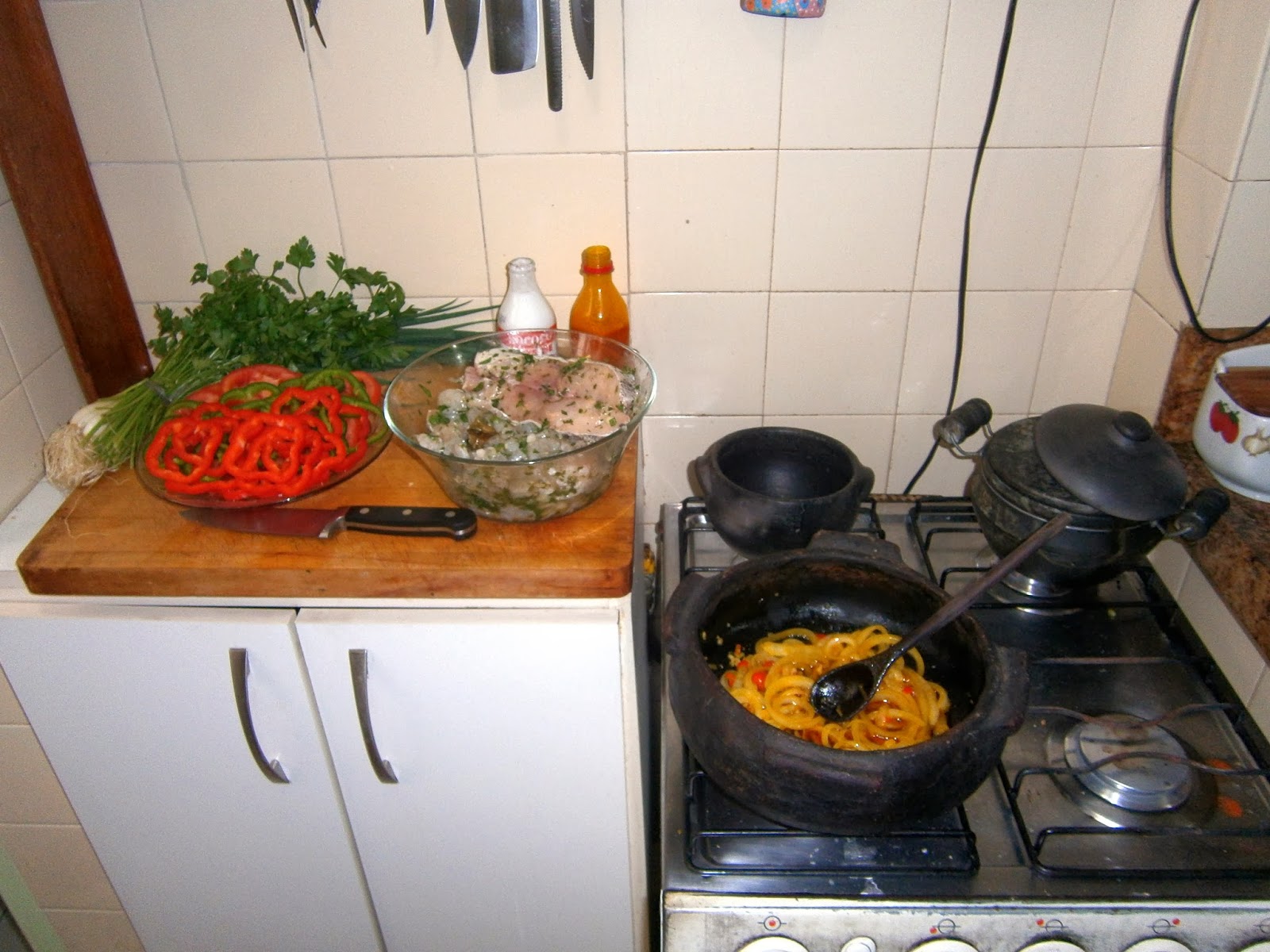
Few meals excite me as much as a seafood moqueca over rice with a tasty pirão. Include a fresh salad and I will think (no, I will know) I have died and gone to heaven. If everything is cooked in clay or stone pots it most certainly inspires a blog post.

A couple weeks ago I met a young neighbor who had never been to Niterói’s remarkable fish market. It always surprises me when I, the gringo new resident, know more about local treasures than folks born and raised here. I guess that is not all too surprising. Some of our friends who have lived here all their lives have never been to Sugarloaf or Corcovado in Rio. To be fair, I lived in San Francisco for more than 8 years before I finally visited Alcatraz Island (and then only when taking a tourist friend to see the place).

At any rate, I used my recent craving for a mouth watering moqueca as an opportunity to show my new friend what he has been missing in terms of quality fresh seafood at discount prices available only at the São Pedro Fish Market.

Some people like a fish moqueca. Others like a moqueca swimming with plump, flavorful shrimp. Me – I say use them both. If you are going for a full on seafood moqueca you may want to include mussels or clams, and maybe some squid, but for the sake of avoiding local mussels pulled from our polluted bay and the near-certain rubbery squid that would result from over cooking (it is a stew, after all, and squid is super tricky when it comes to cook times), I went with just fish and shrimp. Simple and delicious.

We perused the numerous stands at the market hawking shrimp in various sizes. I bought about ¾ of a kilogram from the cutest fish monger I could spot who was still selling his morning catch of crustaceans at a decent price. I paid R$10 even. They were pretty big little guys. I was happy.

For fish I went with two big steaks of firm flesh dorado, a little less than a kilogram overall. It is best to choose a fish with a firm flesh so that it holds its shape and does not disintegrate when cooking in the stew. I think I paid about R$8 for the fish, total.


Back in my kitchen the first order of business was to shell and de-vein the shrimp. I saved the heads and shells and boiled them up with some chunks of onion, celery, a bay leaf and salt and pepper to get a simple broth I would use later in the pirão.

After looking up a few Bahian-style moqueca recipes online I cross referenced that with what Luiz said he usually does. It’s essentially a fish stew made with coconut milk. You can feel your way around and do what pleases you without really running the risk of ruining anything. Just don’t overcook your seafood and you will be OK.


Here is approximately what I used:

- the fish and shrimp
- a red and a green pepper, sliced into thin rounds
- one large onion, sliced into thin rounds
- several cloves of garlic, crushed
- several tomatoes, seeded, sliced crosswise
- a couple little hot peppers, seeded, chopped fine
- a bunch of cilantro and scallions (cheiro verde), chopped fine-ish
- 400 ml coconut milk
- dendê oil for frying (this is the crucial ingredient for getting that Bahian flavor)

You will also need about a cup of yucca flour (farinha de mandioca) for the pirão.

The stew does not take very long to cook so be at the ready with your ingredients and cooked rice. You may want to fuss over a salad in advance. The pirão is quick and can be made after the moqueca is simmering. Just be mindful that once you add the fish and then the shrimp to the stew you don’t want to cook the crap out of it. Less is more when it comes to cooking fresh seafood.

So here we go.

Prepare your rice the way you like it. Have your shrimp broth strained, hot and at hand.

Luiz likes to marinate the fish and shrimp while working on everything else. So we finely chopped some onions, garlic and cheiro verde and mixed them with some olive oil. Then we tossed the shrimp and fish steaks in this oil mixture and set aside. I think you could skip this step if you are somehow pressed for time, but it is a tasty step.

Pour a couple tablespoons of dendê oil into your clay pot. Keep in mind that the flavor of the oil is quite strong. You want that flavor, just not so much that you overpower everything. Think curry – it tastes great – but a little goes a long way. If you like to drown things in oil for cooking, use half and half with canola oil. Heat the pot and the oil over medium high heat.


Toss in and sauté up your onions and garlic. Everything will take on the characteristic orange color of the dendê. Things should smell pretty wonderful at this point, taking you back to the streets of Bahia. Reduce heat and add the sliced peppers and chopped chilies. Cook just to soften. Add the coconut milk, about a cup of shrimp broth and the chopped cheiro verde. Salt to your taste. Bring the mixture to near boiling. Gently add the fish steaks and cover with a couple layers of sliced tomatoes. Cover and cook slowly for a few minutes, until the fish is nearly cooked. A few minutes before you are ready to serve, stir in the shrimp. Cover and cook until the shrimp are cooked, but not obliterated.


Scoop out a few ladles of your yummy, fabulous moqueca sauce and add it to about 1.5 cups of the hot shrimp broth. Bring to a boil. While stirring constantly, slowly sprinkle in the yucca flour until you have a thin meal (thinner than polenta). Heat slowly and continue to stir. The mixture will thicken as it cooks. Be careful not to add too much yucca flour or things will get thick and sticky. You want it thin, yet with some texture. For a real treat add a couple chopped up shrimp and some shredded fish from the moqueca. Stir, salt and otherwise correct seasoning to your taste, cover and set aside. It’s ready when you are but don’t delay too long. It continues to thicken over time.

OMG – I’m drooling just typing this. 


Set the table or just call your family to serve themselves from the pots on the stove. Fish and shrimp moqueca, rice, pirão and a bright salad. It doesn't get any better than that!


Thursday, October 24, 2013

In celebration of the humble Brazilian dish towel


If you live here you definitely have one. I’m willing to bet that we all have at least five or six. Between the three or four we have received as gifts and not yet used (still sitting in a closet), the several in the kitchen drawer currently in rotation, and the four or five well worn and soiled towels since moved on to the household cleaning buckets, we are probably currently tossing around more than a dozen panos de prato in our apartment.

Re-purposed from previously-used cotton sack material, the pano de prato (kitchen, dish or ‘tea’ towel) is ubiquitous in Brazilian homes. You can pick them up cheap, in their most basic and plain style, on the street from the guy selling them in various sizes and weaves for about $R2 a pop. They work great for exactly what they are intended.


What tickles me is how many versions of the towel you can find. Some are simply crocheted around the outside edge to let you know it is for your dishes and not your floor. Others have been delicately embroidered with geometric patterns or kitchen images. Home sewing machines have moved grandmas everywhere to secure appliqués of every happy description, dressing up the sack cloth.


In nearly every tourist town we visit there is an older guy (usually more than one) sitting on the sidewalk or on a planter’s edge in the central square with a display of panos de prato embroidered (most certainly by his wife back at the house) with a “Remember such-and-such” on them for sale as souvenirs.


Our re-gifting drawer, filled with things we were given but now plan to give to other unsuspecting recipients, is brimming with beautifully painted, embroidered or crocheted towels that come our way on a regular basis.

The painted ones look great, but all that acrylic paint would seem to run at cross purposes to the need for the towel to actually dry a wet plate.


In any event, the humble dish towel is a cute feature in every Brazilian kitchen. They are work horse dish towels that turn to decent floor rags when they get too grey for next to the sink.

I use a bleached and sterilized one to strain my soy milk meal when making my own tofu.

Simple joys: turning something old into something new. Being practical in just the way your mother taught you – and her mother taught her. Never throwing anything away. And keeping it all so cheerful.

The pano de prato. It’s quintessentially Brazilian.