Showing posts with label Development. Show all posts

Sunday, August 24, 2014

Trindade - the way it was before

The secret to traveling in Brazil is to get to these bars before they put in a floor, walls and air conditioning!

Brazil is changing year after year. Some say for the better; some say otherwise. As travelers throughout Brazil, Luiz and I have seen a lot of “evolution” at the natural places we love to visit. What I have witnessed over the past 15 years, in terms of the development of previously rural or sparsely populated coastal areas, is a fraction of the changes Luiz has seen since his early adventures as a teenager. He and his friends were frequent campers on beaches and in tiny towns long before comfortable pousadas appeared on the scene.

Sorry Cabo Frio. Not my favorite beachfront view.

Sometimes the “progress” is stark and ugly. I think it is safe to say that Cabo Frio is a fail, having lurched blindly into the fast lane of tourism development. While the beach has stayed clean and the water remains spectacularly clear and crystal blue, you need only look behind you to the burgeoning little city and its wincingly soulless, crowded and chaotic beach-town tourist lowest-common-denominator “development.” Hint: if you want to visit the beautiful sea near Cabo Frio (without doing the whole European upscale thing of Buzios) set your sights on neighboring Arraial do Cabo.

Arraial do Cabo: still a small town - with lots of beaches, and just a cab ride from Cabo Frio.

This post, however, is meant to focus on the success story (so far) that is Trindade.

Luiz and I have been to Trindade in the past. You can learn more about our first visit (and see photos of a very fat Jim) here. At that time we enjoyed a small coastal hippie town that was slowly morphing before everyone’s eyes into a burgeoning (on a tiny scale) coastal getaway for the Paulistas escaping their urban zoo for a weekend. We felt lucky to have been there before it was totally overrun.


During our first visit to Trindade we loved the fact that the tiny, winding access road that enters the village literally traverses a stone waterfall/spillway where the forest meets the sea. No bridge, just a shallow stream of water easily driven through. This bit remains exactly the same.

That wonderful lunch from years ago.

It was our birthdays when we first visited (as it was, again, this second time around) and we ate a spectacularly generous and delicious seafood pasta in a clay pot lunch at a beachside restaurant. I remember thinking at the time that the restaurant was clearly a “temporary-turned permanent” type of structure plopped down on the sand just out of reach of the tide. It was convenient and had great views/ambiance, but it was also an eyesore on an otherwise pristine tiny beach in a natural area. There were several such invasive restaurants lining the shore.

This past May we revisited Trindade on a day trip down from a beach house retreat just outside of Angra dos Reis. It was our birthdays and we were spending a long week touching base with some of our favorite local gems: Ilha Grande, Paraty, Angra do Reis and Trindade.

I had my heart set on a return visit to the restaurant for that amazing seafood pasta.


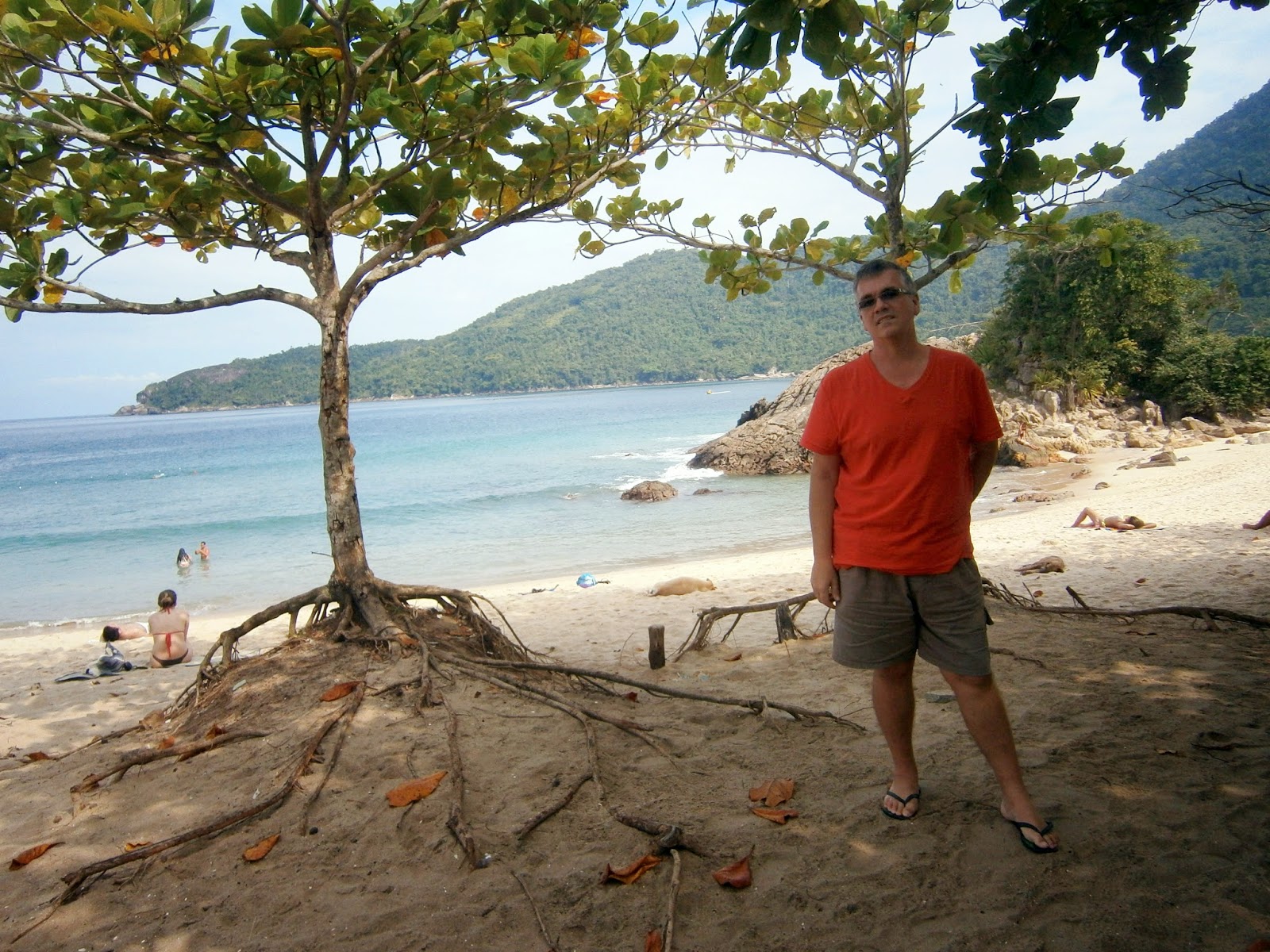
Imagine my surprise (and heartwarming delight) when we hiked out to the little beach and found it totally bare of any built structures. None. Nothing. Just a woman selling cold beverages from a cooler – and a beautiful natural beach!


Could it be? Is it possible? Could IBAMA (the Brazilian Institute of Environment and Renewable Natural Resources) actually be enforcing environmental laws? Did IBAMA actually kick squatters (even delicious seafood pasta making ones) off of environmentally sensitive national forest land? According to the itinerant cold drinks saleswoman that is exactly what happened.

No buildings... yay.

I am standing where the restaurant used to be.

Cue swelling music. Yay! Thank you IBAMA. Thank you Brazil. Yay!!
The beach at Trindade (one of them, there are many) the way it was 20 years ago! Go visit. Go see for yourself.

Looking up from the water - Luiz is where the restaurants used to be. There are small traces of cement floors still in the sand.

Now if we could just put a limit on how many Paulistas can override the place on a holiday weekend. But hey… I don’t blame them. It is a beautiful place.

I love this shot of the bus stop at the edge of town.

And speaking of beautiful getaways that remain natural - don't forget the Juatinga Ecological Reserve that is located along the coast between Trindade and Paraty. We have had some great times there too.


Wednesday, April 30, 2014

Brazil is changing before my eyes

As I remember it.

My first visit to Brazil was in 1999. Luiz and I had met early in the year in San Francisco, CA and he soon thereafter began encouraging me to buy a plane ticket to Rio to join him on the beach in Copacabana on NYE for the millennial fireworks. Tempting as it was I was hesitant to lock in a plane ticket months in advance for a trip with a guy I was not sure I would still want to be spending time with. Little did I know Luiz has an instinct for these sorts of things. I’m glad I secured a seat on that plane.

Brazil has changed a lot in the past 14+ years. Some of the things that enamored me with the country at first blush have since faded into history, like the relative lawlessness in everyday life and the liberty that it provided. But also, some of the things that have begun to fade into history have been met with relief, like the relative lawlessness in everyday life that is better suited to a vacation than a daily living situation.

The town matriarch's house is closed up now.

Luiz and I spent this past long Easter weekend with friends in one of our favorite nearby mountain villages: Boa Esperança. I can’t say for sure, but I think the year-round resident population is something like a few hundred, if you also include the dogs, horses and VW Beetles. As tiny and remote as it is, Boa Esperança has certainly changed in recent years.

Dora and Sergão have upgraded their rental from a teeny tiny place to this beautiful three bedroom palace.

It’s not a big thing (well, maybe it is). Not too much has changed. But you can definitely feel change/progress/lost simplicity in the air.

The old dirt road is history.
Now the road is paved. But the air continues to be crystal clear.

Local residents are happy about the recent paving of the road up from neighboring Lumiar. The asphalt now extends all the way to the final intersection in town (although it does not branch outward onto intersecting residential roads). At least now the bus can reach its turnaround point without herniating the spinal disks of its passengers. This is a great improvement if you live there. For us occasional visitors it has removed some of the romance.


The waterfall on private land a good 1,000 meters up the mountain beyond the end of the pavement has morphed into a more developed family picnic spot. Gone are the days of calling out a hello to the owner and his wife when entering, swimming alone in the waterfall, and then being among just your friends and a few additional folks back in the picnic area. Now there is a full-on bar and luncheonette with extensive seating. The newly improved cement path that steeply descends from the access road to the property helps you not rip apart another pair of flip flops. But, unfortunately, now there is a young man sitting at a plastic patio table at the bottom ready to collect a R$3 entrance fee. I don’t blame the family for commercializing their hidden treasure. It is a good idea and it was bound to happen.


I just miss how it used to be. Sappy, I know.

Our decision to move to Brazil 6 years ago was rooted in family obligations, a desire for a lifestyle change, and plain ol’ whimsical adventurousness. The simpler nature of much of the Brazil we have chosen to surround ourselves with has been a balm on many levels. I get it that time rolls along and things progress. Far be it for me to dismiss the very real improvements in people’s lives that things like paved roads, nearby health clinics or internet access provide. I’m generally pro-development.

At least the banana trees are still giving bananas the good old fashion way.

A lot can be written about the changes I have seen these past 14 years through my significantly narrow experience since we became full time residents. Perhaps this post will elicit from me a longer essay on just that topic. At this point let it suffice to say that Luiz and I choose to surround ourselves with the better nature of rural communities, focus on our relationships with friends who share our values, and live in the present, resisting the temptation to surge ahead into a new Brazil that we fear will come to look all too much like the US we left behind.

Monday, August 5, 2013

Brazil is a Third World country, remember?


Lately all eyes have been on Brazil. Whether you are a fan of the pope and watched as millions descended on Rio while it stretched its capacity to host enormous crowds, or an international travel agent already booking lodging and sightseeing packages for upcoming World Cup and Olympics visitors, or an ambitious investment fund manager making exciting new inroads into the Brazilian market that has (until recently) been outperforming many of the tired and failing options in your home country – chances are you have been wide-eyed about Brazil and its explosion onto the world stage as an all around powerhouse and emerging world hot spot.

Outside perceptions and media generalities can be deceiving.

A lot of people don’t like it when you refer to Brazil as a Third World country, especially some Brazilians. My experience, however, has been that it is Brazilians in particular that default to this kind of language. Some residents seem to use this expression as a way to explain away or justify some of the current national shortcomings and others, especially those now living abroad, would seem to use it to justify to themselves why they left their country in the first place.

I have steered clear of this label in favor of the more politically correct “developing country” mantle. My intention is to be accurate (i.e. not including Brazil among the so-called First World nations) while also trying not to give an exaggerated impression of undeveloped or backward that people may imagine when hearing “Third World.”

As described in Wikipedia, “Third World” and “developing” are seen as interchangeable terms when describing Brazil, but the term Third World is a bit antiquated since it originally simply referred to countries not aligned with either NATO (First World) or the Communist bloc (Second World). Over time the term Third World has come to be used as an economic term to describe poorer countries that have struggled to attain steady economic development.


There are no universal, agreed-upon criteria for what makes a country developing versus developed and the term Third World is rather squishy. I have come to be comfortable with the term “developing country” to describe Brazil because it seems (to me) to imply hope and real progress, leaving Third World to those times when I want to be deliberately provocative.

As long time readers of this blog know, I love Brazil. Luiz and I have never had second thoughts about our move to here nearly 6 years ago and we have no intentions to relocate any time soon. My blog is filled with all the reasons you might want to join us in this mid-life change of adventure we have created for ourselves. Here there is no shortage of daily wonders to soothe the soul and reinvigorate one’s zest for life. Brazil and Brazilians have a special kind of wow that we have experienced in few other lands – and we have visited many, many places. But yeah, when you peel back the travel brochure cover and look for the fine print, there it is: Brazil is still a developing country.


This comes as no surprise to those of us living here. While the television coverage of the upcoming World Cup and Olympic Games may focus on shiny new sports stadiums and grand openings at fancy new resort hotels, a peek behind the scenes reveals promised modern airports still in the early stages of construction (one still lacking paved roads to and from) and public policies that are displacing poor residents to make room for temporary international tourist conveniences. Rumors of political corruption, stolen public funds, illegal construction code violations and broken promises that urban development for the games will include vital infrastructure improvements for permanent residents take no one by surprise.

Persistent political corruption at all levels and shameless kowtowing to international capitalist pressures spawning shiny new millionaires at the expense of true democratic self determination and shared prosperity are the unfortunate tell tale signs of a “developing country” trying to get sturdy legs under itself. Generations of Brazilians have reluctantly grown accustomed to and somewhat hopeless regarding the stench of this political sewage and the oppressive economic inequality it sustains. Plus there are the pervasive legacy costs of political and family dynasties that have concentrated power and wealth over the years. [According to the celebrated Brazilian economist Marcio Pochman, published in the book “The Rich of Brazil” (2004), the assets of five thousand ‘very rich’ families, which account for 0.001 percent of all Brazilian families, amount to approximately 40% of the Brazilian Gross Domestic Product.]

That’s the bad news.


The good news is that Brazil is, indeed, developing. This development has been at a rather impressive pace in recent decades. Modernization in urban areas, in the commercial sector, in all areas medical and, more slowly, concerning the infrastructure that links vital population and resource centers across the country has been steady and persistent. Political reforms, while slow and somewhat limited in scope, have also been steady. Both dynamics have resulted in real and tangible improvements in the quality of life for tens of millions of Brazilians. And just like everywhere else on the planet, the internet has transformed nearly everything among those with access and among those who benefit in secondary and tertiary ways. Things are definitely looking up (i.e. developing).

What this means for Luiz and I is that, while we live in Brazil, we live in a comfortable two bedroom  apartment just down the street from a beautiful, mature urban park. We wash our clothes in a 10 kilogram capacity washing machine (although, it does not have a hot water option and we do not have a dryer, but hey…) and our refrigerator has a separate (although quite small) freezer compartment. Wireless internet service and an over-sized flat screen TV (with 3-D capability, although there are no 3-D signals in our area) as well as an imported, firm, queen size mattress round out or creature comforts.

Most of our banking is done either online or via an ATM machine, although Luiz has developed a meaningful friendly relationship with our branch manager in case of difficulties. Luiz has a cell phone, while I have eschewed said ball and chain. Most of our transportation needs are covered by bus and ferry services but our friends drive chic new cars that run on gasoline, alcohol and/or natural gas.

Regarding medical needs, we live in an insanely convenient part of town chock full of doctors’ offices, labs, ambulatory clinics, critical care facilities and full-on hospitals. We pay a relatively small monthly fee for supplemental private health care insurance that sweeps us up and over the inconveniences and limitations of the public health system, although in any possible circumstance we have medical care available.


If you squint a little and don’t try too hard to find any cracks, it looks a lot like a First World lifestyle. Most of the time it even feels like a First World lifestyle. But then, if you insist on seeing the glass half empty there is plenty to remind you that things are not all that they might first appear to be. For a listing of daily inconveniences and nearly unbelievable tales of stifling bureaucracies I kindly refer you to other blogs.

Mainly what affords us our comforts is that first and foremost we live in a modern, urban area that has been developing as a Brazilian city for more than 300 years. At some point you get paved roads, clean reliable drinking water, backup electrical power at hospitals and a police force with at least a minimum of training and support [key word: minimum]. Second, there are employment options in the area that provide a livable wage or better, and schools and universities are plentiful [even if they often lack a full complement of functioning light bulbs or ceiling fans].

Not bad, overall. But this is certainly not the case for the multitudes in the population that live in less developed cities and towns, favelas adjacent to rich urban areas and the more desperate rural parts of the country. This is where much of the Third World reality exists.


In Brazil as a whole about 35 per cent of the population lives in poverty, on less than two dollars a day. This is most visually represented by the various favelas, or slums, in the country's metropolitan areas where residents suffer with economic underdevelopment and below-par standards of living. In Brazil’s rural areas poverty affects about 51 per cent of the population. This means that Brazil has about 18 million poor rural people, the largest number in the Western Hemisphere. Poor rural communities live in disadvantaged conditions: education and health facilities are not readily available, water supply and sewage systems are generally inadequate, and rural people face severe constraints in accessing technology and infrastructure. [sourced here]


The degree to which you feel the “developing” part of living in Brazil is directly related to your place on the class ladder. Here people with money generally have A LOT of money and can buy their way into a pretty good facsimile of a First World lifestyle. Poor folks, as usual, are shit out of luck. The oft-touted newly emerging Brazilian middle class (myth for a future post) tends to enjoy just enough of an income to buy into a look-alike First World lifestyle without the political/economic/consumer goods quality underpinnings to back it up. [Aside: the vastly expanded consumer credit market in this regard is a ticking time bomb.]

Visitors to Brazil quickly notice the gulf between the haves and the have-nots. Years of government investments in the tourism sector has bolstered the infrastructure for travelers so they can have more of a modern, convenient experience. Tourists who never leave the beaches in Rio and who cannot understand the Portuguese newsprint or television reports may never know they are vacationing in a developing country.


We who live here know Brazil is in a state of development. The struggles to develop are not subtle or inconsequential to our regular lives. Political push back from the general population against governmental corruption and incompetence has been on the rise. The growing number of people lifted out of poverty in recent years (thanks to some good governmental action) has created a new class of citizens who have no intention of going back to the desperate poverty they left behind. At this point it is develop or bust. But it is not easy and it will take more time.


So if you are among the throngs who will be coming to Brazil for the 2014 World Cup or the 2016 Olympic Games, be patient with us. We really are trying to provide you with a comfortable, drama-free adventure. But we are also trying to get reliably clean drinking water and doctors on call to millions of our fellow countrymen and their families.

Wednesday, May 1, 2013

Brazil is not the United States


Brazil is not the United States. I like that about Brazil. Actually, I really like that about Brazil.

From day one when I first visited this country 13 years ago I loved the fact that vendors walk the sand at beaches everywhere selling cold beverages, warm fresh foods, sun bathing products, sunglasses, bikinis, children’s play toys and whatever else you may desire. I like that about Brazil. In Salvador we even had a little boy come by our spot on the sand every 15 minutes or so and empty a garden watering can over our feet to cool us down (for a small tip). Cute!


To my mind, street vendors selling beverages, hot dogs, Xtudos (cheese burgers w/ everything), ice cream – and on and on are a convenience when hanging out at a block party or waiting for the party to get started inside the Sambadromo.

Is the bus stuck in traffic? Hop on the back of a motorcycle and pay a Motoboy to get you to your destination on time, zig zagging between the backed up cars and trucks. Or, if you are on the bus, reach out the window and buy an ice cold water (or beer) and maybe a package of cookies from a vendor walking up and down the lanes in the traffic jam.

Brazil is not the United States. In the States these kind of entrepreneurial efforts would be forbidden by law or so severely regulated as to significantly reduce the convenience and surely raise prices.


Living in Brazil I can do without the seemingly ever expanding desire by many to “Americanize.” I want to warn people that it is the wrong path forward and that they should be careful what they wish for. But I can understand how television presents the illusion of universal wealth and carefree consumption in the US and how this then ignites a desire in people to get some for themselves – or for politicians to promise they can deliver these wonders once elected.

Personally, I like the fact that 2 liter plastic soda bottles are so thin they collapse under the slightest squeeze (consuming less plastic!) And it seems better in the long run to raise your children with small or very small soda or ice cream portions (which are still quite satisfying) rather than always tilt toward a wasteful and dangerous Super Size for everything.

It is my hope that Brazil will resist the temptation to emulate all that is “American” for as long as possible. Unfortunately, the class dynamics here are very pronounced and the rich seem to reach for the “American” version of things. Thus setting a coveted example. Alas. Television, advertising, peer pressure, all the usual suspects, are homogenizing so many facets of Brazil’s amazing multifaceted cultural expressions. And they are moving us all toward a more wasteful, consumption oriented way of life (among other things).

This “progress” is already infringing on our local experience in a big way. Sadly, it appears to be a tide that will not be reversing any time soon.

Right next to the "Whole Foods" look alike grocery.

Don’t get me wrong. I am grateful for economic progress and how some of this has lifted some (quite a few, in fact) Brazilians out of severe poverty. But being like “America” in and of itself is not synonymous with progress or good. I would argue that Brazilians have created a proud, uniquely multicultural history which can progress all on its own without morphing into a USA clone.

The motivation for this post came from a walk through our neighborhood recently that made me a bit sad. The first Starbucks coffee shop has opened near our apartment (which looks identical to all those I have seen in the States). To my disbelief there is a new (franchise) sports bar named All Games that features US-style football. WTF? (Who goes there?). The worst of it all was discovering a new Burger King opening at an intersection that already has a McDonalds, Dominos Pizza and Subway sandwich joint. Argh – my neighborhood is becoming an “anywhere USA” junk yard.

Value meals start at R$18

You pay for delivery.


Three slices of meat per sandwich.

If you can find someone in my neighborhood who knows who played in the Super Bowl, I will buy you a venti  Starbucks 4 shot espresso latte with a pump of vanilla syrup.

Brazil is not the United States – and I have always liked that about Brazil. Too bad the status conscious young professionals in the neighborhood are willing to spend R$9 or more for a latte. I have a secret desire that people who grew up drinking a 2 ounce shot of coffee after lunch will not switch to a ‘grande’ or ‘venti’ super sized dose of corporate Kool Aid.

Sunday, January 29, 2012

Favelas in Rio and some context


Favelas in our community and throughout Rio and indeed across Brazil pose a difficult challenge to government, which simplly does not know how to address this permanent underclass situation, or perhaps chooses not to address the problem/suffering/poverty.

Many so-called middle class Brazilians and the more affluent generally look down their noses at the residents of favelas and often characterize the communities as crime ridden and violent.

When I first proposed to my family here that I wanted to go to the Rocinha favela community to see how I might be able to bring my 30 years of nonprofit community service experience to bear, my MIL went through the roof. She was sure I would be shot dead upon entering the neighborhood. She was quite literally blinded by her preconceptions. I was not deterred.

Several years ago Luiz and I traveled to several Greek islands, where the neighborhoods' spacial layouts were remarkably simmilar to the cramped reality of Rio's favelas. But there the communities had been developed and supported and indeed turned into tourist meccas. Tomato - Tomäto.

Here is a good article, translated on the very fine blog Rio real that explores the cultural vibrancy in Rio's favela communities. Check it out. And bookmark Rio real for future reference. Thank you Julia Michaels for your dedicated work.

Tuesday, December 6, 2011

Brazil seems to be thriving


I´m not an economist - nor do I claim to be one on TV or the internet. But I have to say that Brazilians seem to be spending $$ in record numbers.

Luiz and I recently went to the mall to buy a computer. The place was PACKED! Not just the electronics\home appliances stores we visited - but the entire mall.

Wallets seemed to be open. People seemed to be buying. Sales people were definitely busy.

It did not look like a poor country to me. Brazil has changed.

Make no mistake - there are a gazillion poor people in Brazil - and consumer goods are rediculously expensive. But a trip to the mall had me thinking about everything upsidedown.

Who are these people with all this money? Why is this place so packed?

We don´t live in the richest of cities (although Niterói is consistently voted "Best Quality of Life" in Rio de Janeiro state...) Is it the credit bubble? Are people really able to buy refrigerators? I´m looking over my shoulder waiting for the other shoe to drop.

But there is home\apartment construction everywhere. There are municipal improvements happening at the library, the old city hall, the ferry terminal, road expansions. Looks like improvement to me...

Unless and until I hear a pop in a bubble, I´m going to hold on to the belief that things are getting better for many Brazilians.

Am I dillusional? What have you noticed?