Showing posts with label Nature. Show all posts

Sunday, August 24, 2014

Trindade - the way it was before

The secret to traveling in Brazil is to get to these bars before they put in a floor, walls and air conditioning!

Brazil is changing year after year. Some say for the better; some say otherwise. As travelers throughout Brazil, Luiz and I have seen a lot of “evolution” at the natural places we love to visit. What I have witnessed over the past 15 years, in terms of the development of previously rural or sparsely populated coastal areas, is a fraction of the changes Luiz has seen since his early adventures as a teenager. He and his friends were frequent campers on beaches and in tiny towns long before comfortable pousadas appeared on the scene.

Sorry Cabo Frio. Not my favorite beachfront view.

Sometimes the “progress” is stark and ugly. I think it is safe to say that Cabo Frio is a fail, having lurched blindly into the fast lane of tourism development. While the beach has stayed clean and the water remains spectacularly clear and crystal blue, you need only look behind you to the burgeoning little city and its wincingly soulless, crowded and chaotic beach-town tourist lowest-common-denominator “development.” Hint: if you want to visit the beautiful sea near Cabo Frio (without doing the whole European upscale thing of Buzios) set your sights on neighboring Arraial do Cabo.

Arraial do Cabo: still a small town - with lots of beaches, and just a cab ride from Cabo Frio.

This post, however, is meant to focus on the success story (so far) that is Trindade.

Luiz and I have been to Trindade in the past. You can learn more about our first visit (and see photos of a very fat Jim) here. At that time we enjoyed a small coastal hippie town that was slowly morphing before everyone’s eyes into a burgeoning (on a tiny scale) coastal getaway for the Paulistas escaping their urban zoo for a weekend. We felt lucky to have been there before it was totally overrun.


During our first visit to Trindade we loved the fact that the tiny, winding access road that enters the village literally traverses a stone waterfall/spillway where the forest meets the sea. No bridge, just a shallow stream of water easily driven through. This bit remains exactly the same.

That wonderful lunch from years ago.

It was our birthdays when we first visited (as it was, again, this second time around) and we ate a spectacularly generous and delicious seafood pasta in a clay pot lunch at a beachside restaurant. I remember thinking at the time that the restaurant was clearly a “temporary-turned permanent” type of structure plopped down on the sand just out of reach of the tide. It was convenient and had great views/ambiance, but it was also an eyesore on an otherwise pristine tiny beach in a natural area. There were several such invasive restaurants lining the shore.

This past May we revisited Trindade on a day trip down from a beach house retreat just outside of Angra dos Reis. It was our birthdays and we were spending a long week touching base with some of our favorite local gems: Ilha Grande, Paraty, Angra do Reis and Trindade.

I had my heart set on a return visit to the restaurant for that amazing seafood pasta.


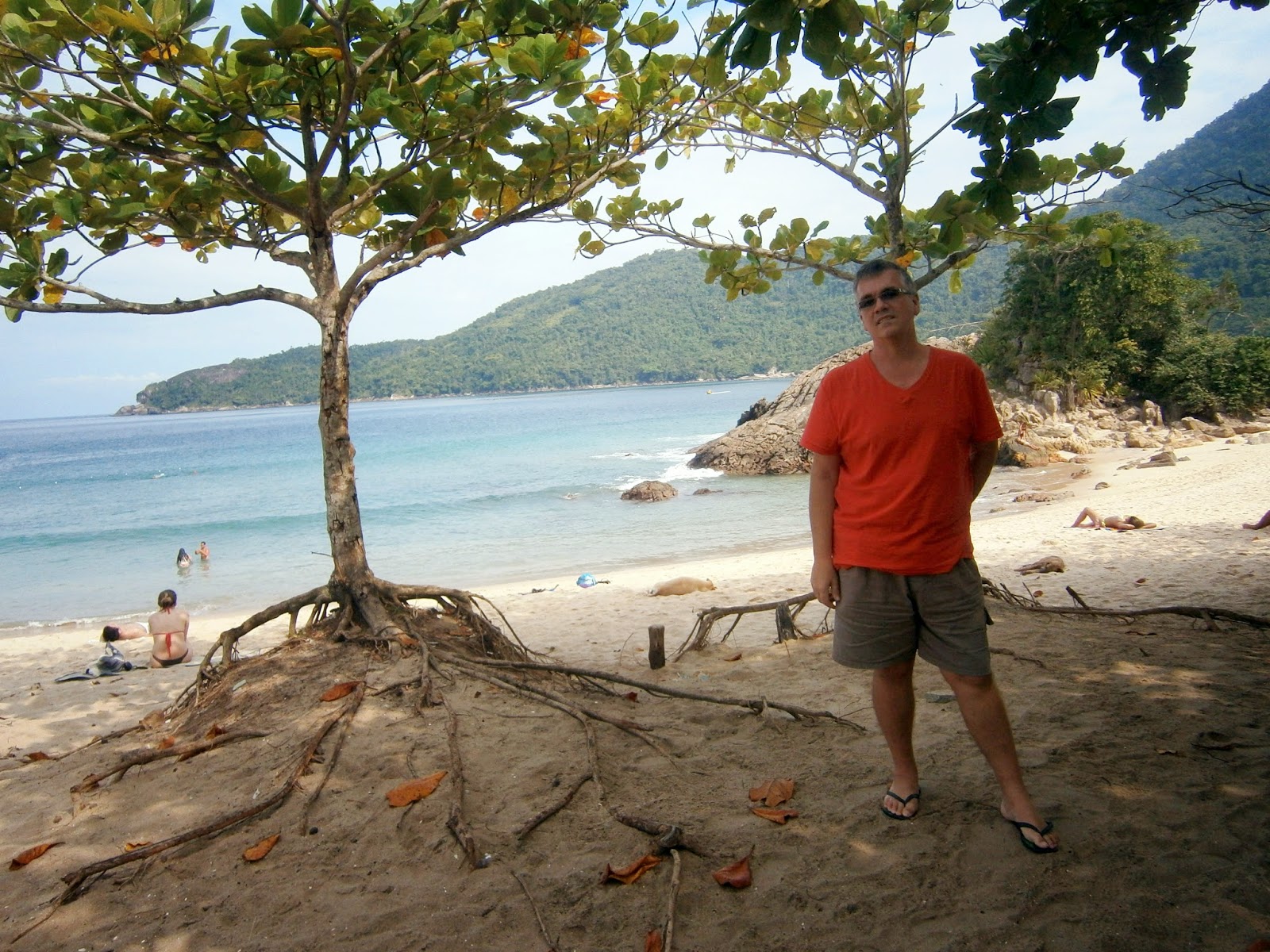
Imagine my surprise (and heartwarming delight) when we hiked out to the little beach and found it totally bare of any built structures. None. Nothing. Just a woman selling cold beverages from a cooler – and a beautiful natural beach!


Could it be? Is it possible? Could IBAMA (the Brazilian Institute of Environment and Renewable Natural Resources) actually be enforcing environmental laws? Did IBAMA actually kick squatters (even delicious seafood pasta making ones) off of environmentally sensitive national forest land? According to the itinerant cold drinks saleswoman that is exactly what happened.

No buildings... yay.

I am standing where the restaurant used to be.

Cue swelling music. Yay! Thank you IBAMA. Thank you Brazil. Yay!!
The beach at Trindade (one of them, there are many) the way it was 20 years ago! Go visit. Go see for yourself.

Looking up from the water - Luiz is where the restaurants used to be. There are small traces of cement floors still in the sand.

Now if we could just put a limit on how many Paulistas can override the place on a holiday weekend. But hey… I don’t blame them. It is a beautiful place.

I love this shot of the bus stop at the edge of town.

And speaking of beautiful getaways that remain natural - don't forget the Juatinga Ecological Reserve that is located along the coast between Trindade and Paraty. We have had some great times there too.


Saturday, June 14, 2014

Finding fresh heart of palm


Hearts of palm. Yum. I love those little babies. I love them in a clean fresh salad. They are super yummy roasted. Pasteis de Palmito are to die for. Palmitos – just plain yum.

When I first moved here I was excited by the idea of moving so close to the source of this delicious harvest. Palm trees. Brazil has a gazillion palm trees. Heart of palm should be a cheap and abundant yummy treat, right? Uh, yeah, not so much.

Turns out that Brazil was one of the biggest “producers” of palm hearts until the 1990s when the “farmers” realized that they had chopped away at most of the wild supply of suitable palm trees and their supply was dropping precipitously. At that point they had to get into the business of actually farming the plant and managing their harvests. So supply dropped for a while.

My purchase. I had the guy machete the edible center out of the outer layers.

Not all of the freelance palm poachers took to farming. Maybe they are out there snatching up wild açai or illegal song birds, or something. But those that did make the switch have seen things get off to a (normal) slow start. So prices are not so low. Plus, they export the really good stuff. So those of us actually living in palm tree heaven wind up paying a little more for a lesser quality product. Ah Brazil. You sure know how to break a guy’s heart. (Real heart, not the palm heart.)

Once cut out the center oxidizes quickly. Gotta get it into water.

At any rate, I saw a vendor at the street market today selling fresh palm hearts, still in the protective outer layers of non-edible palm-ness. Excited to see it so fresh, and reasonably priced, I bought a stalk.
I paid R$10 for what resulted in about 420 grams of yummy edibleness. That compares to a 300g jar sold for R$9. I saved a little more than R$2, relatively speaking. That 300g jar in the States goes for about US$4.25.

Stop. Stop right there. I see you US Americans doing the conversion in your head and saying to yourself: “So, hmmm, R$9 a jar there is just about the same as R$4.25 a jar here. Not bad…”  NOPE. It doesn't work that way. First, I am not a tourist at my grocery store spending my US earned US dollars on a product priced in Brazilian reais. If I earn my $$ in reais, I spend it in reais. So my R$9 is R$9. Then you have to consider that wages here are generally speaking half of what they are in the States for similar work (worse, most often, but let’s not squabble). So in reality that yummy looking little jar of lesser quality domestic brand hearts of palm is costing me, in very real terms (so to speak), a lot more than you in the States are buying it for.  Bummer. So much for moving to Brazil to get a deal on palm hearts.

How it should look after roasting. Yum.

Ah well. Big deal. The point is – it is yummy! And I got a big piece of it for a good deal today at my local street fruit and veggies market. My plan is to chop up half of it for a salad (and to just munch) – and to oil, salt, pepper, wrap in foil and roast the other half and have it with my dinner.

It was a good day at the market – and tangerines are in season too!

Wednesday, April 30, 2014

Brazil is changing before my eyes

As I remember it.

My first visit to Brazil was in 1999. Luiz and I had met early in the year in San Francisco, CA and he soon thereafter began encouraging me to buy a plane ticket to Rio to join him on the beach in Copacabana on NYE for the millennial fireworks. Tempting as it was I was hesitant to lock in a plane ticket months in advance for a trip with a guy I was not sure I would still want to be spending time with. Little did I know Luiz has an instinct for these sorts of things. I’m glad I secured a seat on that plane.

Brazil has changed a lot in the past 14+ years. Some of the things that enamored me with the country at first blush have since faded into history, like the relative lawlessness in everyday life and the liberty that it provided. But also, some of the things that have begun to fade into history have been met with relief, like the relative lawlessness in everyday life that is better suited to a vacation than a daily living situation.

The town matriarch's house is closed up now.

Luiz and I spent this past long Easter weekend with friends in one of our favorite nearby mountain villages: Boa Esperança. I can’t say for sure, but I think the year-round resident population is something like a few hundred, if you also include the dogs, horses and VW Beetles. As tiny and remote as it is, Boa Esperança has certainly changed in recent years.

Dora and Sergão have upgraded their rental from a teeny tiny place to this beautiful three bedroom palace.

It’s not a big thing (well, maybe it is). Not too much has changed. But you can definitely feel change/progress/lost simplicity in the air.

The old dirt road is history.
Now the road is paved. But the air continues to be crystal clear.

Local residents are happy about the recent paving of the road up from neighboring Lumiar. The asphalt now extends all the way to the final intersection in town (although it does not branch outward onto intersecting residential roads). At least now the bus can reach its turnaround point without herniating the spinal disks of its passengers. This is a great improvement if you live there. For us occasional visitors it has removed some of the romance.


The waterfall on private land a good 1,000 meters up the mountain beyond the end of the pavement has morphed into a more developed family picnic spot. Gone are the days of calling out a hello to the owner and his wife when entering, swimming alone in the waterfall, and then being among just your friends and a few additional folks back in the picnic area. Now there is a full-on bar and luncheonette with extensive seating. The newly improved cement path that steeply descends from the access road to the property helps you not rip apart another pair of flip flops. But, unfortunately, now there is a young man sitting at a plastic patio table at the bottom ready to collect a R$3 entrance fee. I don’t blame the family for commercializing their hidden treasure. It is a good idea and it was bound to happen.


I just miss how it used to be. Sappy, I know.

Our decision to move to Brazil 6 years ago was rooted in family obligations, a desire for a lifestyle change, and plain ol’ whimsical adventurousness. The simpler nature of much of the Brazil we have chosen to surround ourselves with has been a balm on many levels. I get it that time rolls along and things progress. Far be it for me to dismiss the very real improvements in people’s lives that things like paved roads, nearby health clinics or internet access provide. I’m generally pro-development.

At least the banana trees are still giving bananas the good old fashion way.

A lot can be written about the changes I have seen these past 14 years through my significantly narrow experience since we became full time residents. Perhaps this post will elicit from me a longer essay on just that topic. At this point let it suffice to say that Luiz and I choose to surround ourselves with the better nature of rural communities, focus on our relationships with friends who share our values, and live in the present, resisting the temptation to surge ahead into a new Brazil that we fear will come to look all too much like the US we left behind.

Saturday, March 15, 2014

Two hidden mountain towns near Ouro Preto

Workers on break enjoying the view in Catas Altas.

Taking the back roads is hands down our favorite way to see Brazil in all its humble glory. Discovering tiny towns with their simple beauty, historic architecture, local pride, living history – and occasionally some fresh cheese or fresh sausage drying in the air to round it all off, count me in.

During our recent visit to Ouro Preto (OP) in Minas Gerais we identified two nearby towns worth exploring: Lavras Novas and Catas Altas.


Just 17 kilometers outside of Ouro Preto is the little town of Lavras Novas. It is sufficiently tiny and located sufficiently close to OP that for governmental purposes in modern history it has been incorporated as a “district” of OP, essentially a far flung neighborhood. But its history tells a much more rich and interesting story.


Founded in 1717 this mountain village served to shelter early gold miners. Historical reports indicate that gold was discovered in this area prior to it being discovered in neighboring Ouro Preto. The central chapel was erected in 1740. Over the years the gold supply dwindled and most folks relocated to nearby towns such as OP. But many stayed behind and worked farms and honed crafts like basket weaving and wood carving. Town representatives would take fabricated goods to Ouro Preto for sale and return with purchased essentials for living. Word is that the town was a rather insulated, hard to reach village living out a rather socialist/collectivist communal strategy.


One tale about the town that many dispute is that by the late 18th century the town operated as a quilombo. Quilombos were towns and villages (even some cities) in Brazil that were refuges for freed and escaped African slaves and their allies. Most were located in remote, defensible locations that offered maximum safety and security for residents from those who would seek to capture and re-enslave them. Given the (then) remote and difficult to access nature of Lavras Novas and its long-time majority black population this tale took root. But others suggest that it was simply too near to Ouro Preto to have been an effective location for a quilombo and that its black residents were freed slaves choosing an alternative, more appealing community to OP.

Whatever the case may be, this present day town of about 1,500 people remains a majority black community that still sports a ridiculously, seriously rugged access road (which, unbelievably, sees daily bus traffic to and from Ouro Preto).

Our casual day trip took us to town just to look around a bit. The town has developed a pretty good tourist infrastructure with pousadas and several eco-tourism adventure services. The surrounding area is great for hiking and includes several beautiful waterfalls.

We just wandered around the central area and took pictures.


Always on the lookout for the unexpected, I spotted an artisan basket studio where we stopped in and bought a few dried gourd cabasa plant holders that Luiz envisioned as creative containers for flower arrangements. Out of the car window while leaving town I caught a glimpse of a sign on the front of a rather worn house that advertised fresh goat’s milk for sale.


Carlos was good enough to stop so we could inquire if they might have any goat cheese for sale. There was a little bell thingy at the front gate with a sign that read: “Ring bell and wait!” Luiz gave it a go and we waited. Rang it again. Then again. We were just about to return to the car when a young man appeared at an open window and called out. After some friendly chatter he offered to take a look in “the laboratory” to see if they had anything firming up.  Then… bingo – we scored. He only had one cake of cheese but he offered to sell it to us for R$15, a quite reasonable price. The next morning over coffee we discovered it was really yummy, a bit too fresh and mellow perhaps, but yummy all the same.

It was thanks to a tip from a fellow back roads traveler on a gringos Facebook group I frequent that I discovered the other nearby town of Catas Altas.  He had posted a link to these terrific images of the town. Carlos assured me it was a brief 70 kilometers drive from OP to get there, so we planned another day trip of discovery.


This place was/is beautiful. It’s plunked on top of the mountains with views in every direction. Typical for the region, Catas Altas was originally an outpost housing gold miners working lucrative mines (or rather, excavations) way up at high altitudes. Thus the name Catas Altas (high excavations). Local records date the original settlement to 1694. The first baptism recorded at the original town chapel was dated in 1712. Construction of the larger church that replaced the original chapel began in 1729. That building, occupying the main town square, still functions today and (in typical showy church fashion) sports a glorious interior that outstrips any other structure  in town in terms of extravagance.

The historic church in the central square.
Dogs in repose at church entrance.


Once we arrived in town we parked near the church and walked to various points in search of further exploration information. You know, the typical stuff: we talked to the lady at the bakery, chatted up the woman at the register at the little market, tried to get some useful information from the woman guarding the church entrance (and insisting on R$2 to enter – even if you just wanted to say a prayer), asked a few questions of the man selling aluminum pots and pans on the curb around the square, checked in with the gals at the pharmacy, and eventually spoke with the woman cleaning the local school library.

As the tourist office was unexpectedly closed (folks said they were surely exhausted from the Carnaval weekend and probably would be open again in a few days – haha), we had to shake down the locals for directions to the nearby waterfall we had heard of. With just one false start out of town and then two wrong turns past the water pipe filling the cows’ drinking pond we finally found the dirt trail of a road that took us to within a short walk of the waterfall.

The view back down to town from the waterfall spot.

 Aside from the waterfall, the town was pretty stingy with its treasures. I am often accused of chasing rainbows when I insist on looking around every corner in these small towns. But my experience has resulted in way more hits than misses in this regard. The really cool stuff (like the fresh goat cheese place) don’t just jump out and grab you. You gotta do some work, especially in places that don’t have a big tourism budget to help visitors find the residents’ art studios or the local historical society (if it even exists).

Public water fountain.

I did find a fresh loaf of sweet coconut bread sitting at the grocery checkout counter for just R$3. That counts as a good find in the absence of more obvious bits of interest.


After a thorough going over, a splash in the waterfall, picture taking and a fine Minas style lunch at a wood fire buffet we called it a day and headed back to Ouro Preto.

This is the delivery entrance to the town's appliance store.


If you plan a visit I must warn you that the mountain area surrounding the town is pretty torn up by big mining companies gouging into the hillside for iron ore. It’s pretty nasty. But fear not. Once you get close to the town the mining fades into the background and you are transported back in history.


Tuesday, February 25, 2014

Our honeymoon in the Visconde de Mauá region in Rio state


There’s nothing like another commitment ceremony to cue up a travel adventure.

This past February 14th marked the 10 year anniversary of Luiz and my then temporarily-legal marriage performed at San Francisco’s City Hall. As a gay couple, settling into a marriage which includes the rights, privileges and protections afforded all married citizens has been an on again, off again experience for us. When your civil rights are put up for a vote in the public square or horse traded by loathsome politicians you often find yourself chasing after those rights into whatever legal margins might offer a foothold.


After one marriage (since struck null and void by the California Supreme Court) and two domestic partnership contracts (one in San Francisco and one in the State of California) we finally took advantage of Brazil’s “separate but equal” Stable Union option, and the 10 year anniversary date, to re-up our “marriage” thing. This legal union in Brazil affords us the rights, privileges and protections (and obligations) of civil marriage throughout the country. It’s a good thing we like each other so much. We have been through more than our share of “commitment ceremonies.”

At the risk of working our friends’ last nerve on this subject we hope to, at a future date, legally convert this contract to a full-on “marriage” in name and substance when (we hope) the LGBT activists in Rio will organize their second annual mass public wedding ceremony. Given the relatively invisible (but ever-increasing) LGBT rights struggle here we think it is important to participate in a public event to draw attention to the urgent need for a Brazil without homophobia. Stay tuned.

If you came to our most recent (re)commitment party and brought a toaster or set of bath towels to wish us well, you need not feel shy about coming to our next without a gift.

But to the point of this post: we just got (re)hitched and it called for a honeymoon getaway.


One of the best facts about being relatively new to Brazil is that there remain many, many cool places to visit that we have never seen before. Our objective for our honeymoon was to identify one such place and take it on with gusto. We settled on the mountainous Viconde de Mauá area in Rio de Janeiro state near to the borders with both São Paulo and Minas Gerais states. The region is both remote, with hiking trails, rivers and waterfalls, as well as populated with scores of pousadas from basic to quite lavish. For the outdoors types this place has something for everyone.

Our chalet.

A good internet search and few phone calls brought us to reserving a chalet at Brilho da Natureza. This place was perfect. Located one kilometer further up the mountain from Maromba it was peaceful and absolutely beautiful. Our chalet was right on the river with a natural swimming area just a few steps from our veranda (although the mountain spring water was COLD).

Pousada central, including the breakfast room.
They have 16 chalets in all over two pieces of riverside property.

The cool mountain air was SO refreshing. We very much enjoyed a privilege most recently withheld from us in Rio’s record breaking heat wave: sleeping in each other’s embrace under a blanket. Honeymoon bliss. Good sleeping weather.


Temperatures during the day were in the 80s but after the sun set the temperature dropped into the 60s. For us that’s pretty chilly weather. We took advantage of the chill to make a romantic fire in our chalet’s fireplace.


Waking up to a super delicious breakfast spread is the hallmark of a good pousada in Brazil. Folks in the States would be blown away by the extent and quality of the breakfast served in even the most modest of Brazilian pousadas. Brilho da Natureza set a high bar in this regard. Nearly all of the baked goods were fresh made on premises: bread, ham and cheese rolls, pão de queijo, cookies, cakes, etc. Plus the cheeses, jams and honey were fresh from area farms. Of course the juices served were fresh as well. To top things off, after we sat down the delightful woman from the kitchen came over (with toddler son in tow) to ask if we would like her to prepare us some eggs. Fantastic.

Our days were occupied hiking to waterfalls. Our evenings were quiet, first walking to and through Maromba (longer to walk the one kilometer to Maromba than to walk around the tiny village) and then snuggling in our cozy chalet.

I’ll shut up and let the pictures speak for themselves.

Busy downtown Maromba.


Cachoeira Porção da Moramba


Luiz taking a blessing at Cachoeira Véu da Noiva (Bridal Veil)


What Luiz made look simple I struggled to complete. Yikes!


Cachoeira do Escorrega


Portuguese speakers will get the joke.

True to our style of adventure we spotted a tiny, makeshift “restaurant” on the banks of the main river in the area. Drawn in by its funky charm (and the big sign advertising fresh grilled trout for 2 for R$25) we decided to enjoy an early lunch to take advantage of this unlikely but super scenic restaurant.

Thanking our proud host.
The trout lunch was fantastic.

After three nights in Maromba we decided to relocate to Maringá just 3 kilometers down the road. Maringá is the tourist hub in the area (exceeding Viconde de Mauá proper in this regard as well). Still a small village, Maringá afforded us more restaurant choices and some boutique shopping as well. The Rio Preto river runs through this tiny town and is also the geographical border between Rio de Janeiro and Minas Gerais states. The town has a decidedly Minas feel, which was just fine with me. I absolutely LOVE comida Mineira (food from Minas Gerais).

The busy main intersection in Maringá.

Shopping is not really our thing, but we love finding a deal and especially love buying from the source as much as possible. While in Maringá we pretty much avoided all the boutiques (except the ice cream and chocolate shops). As an alternative we kept an eye out for “direct from the source” opportunities. As such we bought fresh berry preserves from a woman behind a rickety roadside stand, a jar of unprocessed honey (complete with tiny bee bits floating in the product) from a family tending bees in the area, goat cheese and sausage from a delicatessen featuring local products, and – our favorite – tiny paper flowers and fabric butterflies on long thin reeds made by a local retired pharmacist-turned artisan.

Luiz requested butterflies without the reeds.

Having spotted “the flower lady” on the street making a delivery of her wares to a boutique for resale, we asked how we might reconnect with her in the coming days to buy some of her flowers. She invited us to her home to check out the possibilities. Sorry to say I do not have a picture of Carmen's tiny cottage home/studio. It was super cute: teeny tiny, filled with art, super organized efficient kitchen, steep stairs/ladder to the bedroom loft, and 8 visiting humming birds buzzing around a feeder hanging from an eave over her porch. When we visited we found the cottage a short distance up a driveway to a much larger main house. As is traditional in Brazil, we clapped loudly when approaching the house to signal our visit. Carmen called out from her kitchen for us to enter via the side walkway (the front path had a wobbly stone step). We spent the next hour or so having coffee at her kitchen table, admiring her work, and sorting out which flowers and butterflies Luiz wanted for later use in his own flower arrangements.


We had done well choosing this area for our honeymoon getaway. It was all the nature we could want plus sufficient tourism infrastructure to make it easy and convenient. Pousada and restaurant prices have gone up all over Brazil and that was apparent here as well. But there were still values to be found. Our strategy of arriving late in a weekend and staying through the weekdays worked well to get us good deals on the pousadas we stayed in. It also meant that there was next to no one at the waterfalls we visited. We hiked all alone (except for the huge green snake with half a frog sticking out of its mouth that crossed our path one day) and never saw more than three or four people at a waterfall. Most of our time we were in our own private paradise. But we did learn an important piece of information about little Maringá. It is basically a weekend-only village. Nearly ALL of the shops and restaurants were CLOSED Monday through Thursday. It was kind of weird. But the locals just shrugged and said there was next to no business during the week, so it made sense to them. Be forewarned.